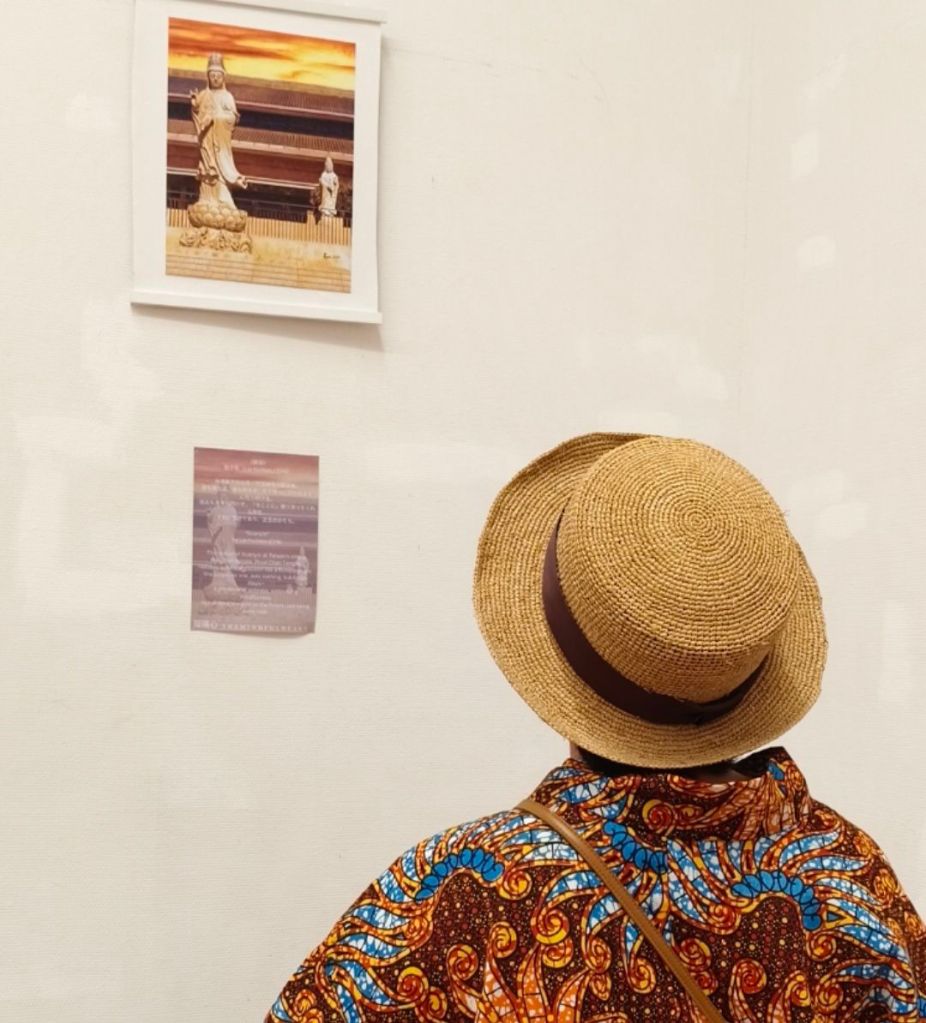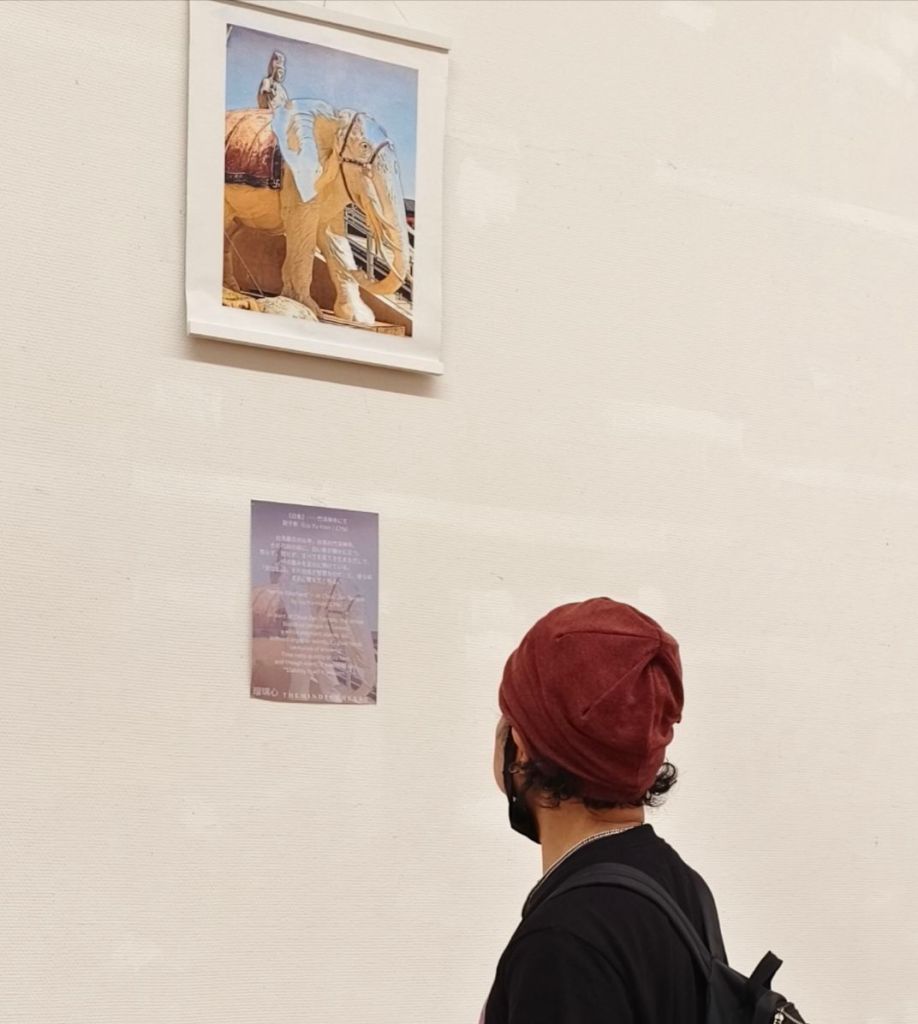
To present the Guanyin of Zhuxi Temple, I made a pilgrimage to Nara’s Kōfuku-ji, founded in 669 and known as one of Japan’s ancient temples. Climbing its stone steps felt like walking inward into the heart. Looking up at the solemn Guanyin, I realized that Zhuxi Temple and Nara’s temples, though across borders, resonate in compassion.
Guanyin is not a distant deity, but the gentleness and mercy within our own hearts. Returning to the canvas, I painted not just an image, but a quiet power of protection understanding that art itself is a pilgrimage of the soul.
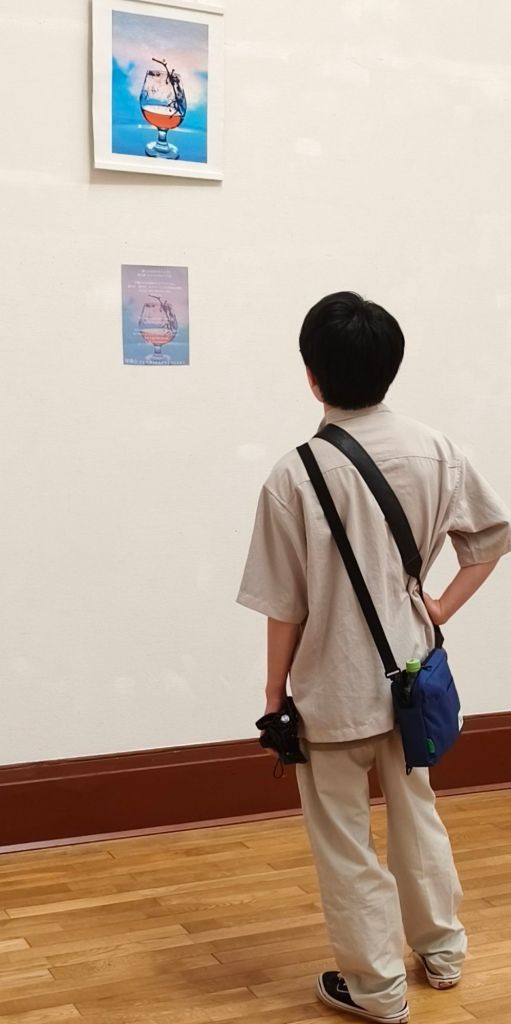
In Cyn’s canvas, the blue of Kenting blends with the rim of a clear glass, like the shimmer of the sea rippling in the heart. A student from Kyoto University’s Department of Physics especially loved this painting, saying it gave him a rare sense of relaxation, as if complex equations and heavy experiments could quietly be set aside in this moment.
Yet within the glass there is no alcohol only clarity. This image of “zero alcohol” reminds us that freedom in life does not come from stimulation, but from dwelling in the present, where the heart’s natural brightness appears.
When we look closely at ordinary things, infinity is revealed. This painting is just that a transparent glass that can hold the vast ease of the ocean and the stillness of life.
Gazing upon it, the world grows still, and the heart grows still. The painting is more than a painting – it is a reminder that a simple and pure way of living is the truest freedom.
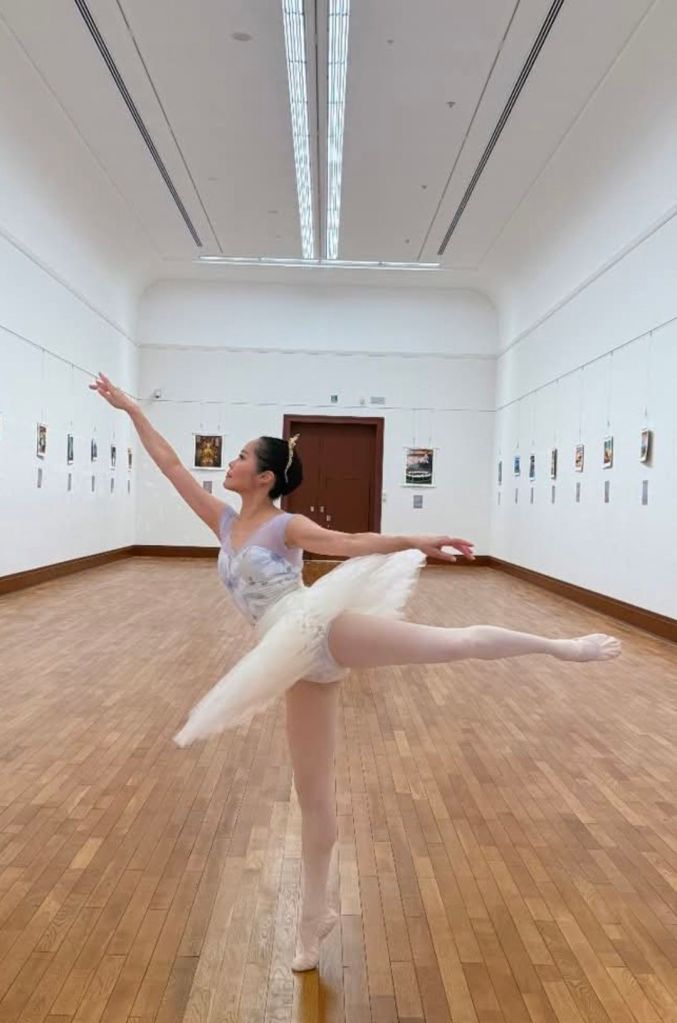
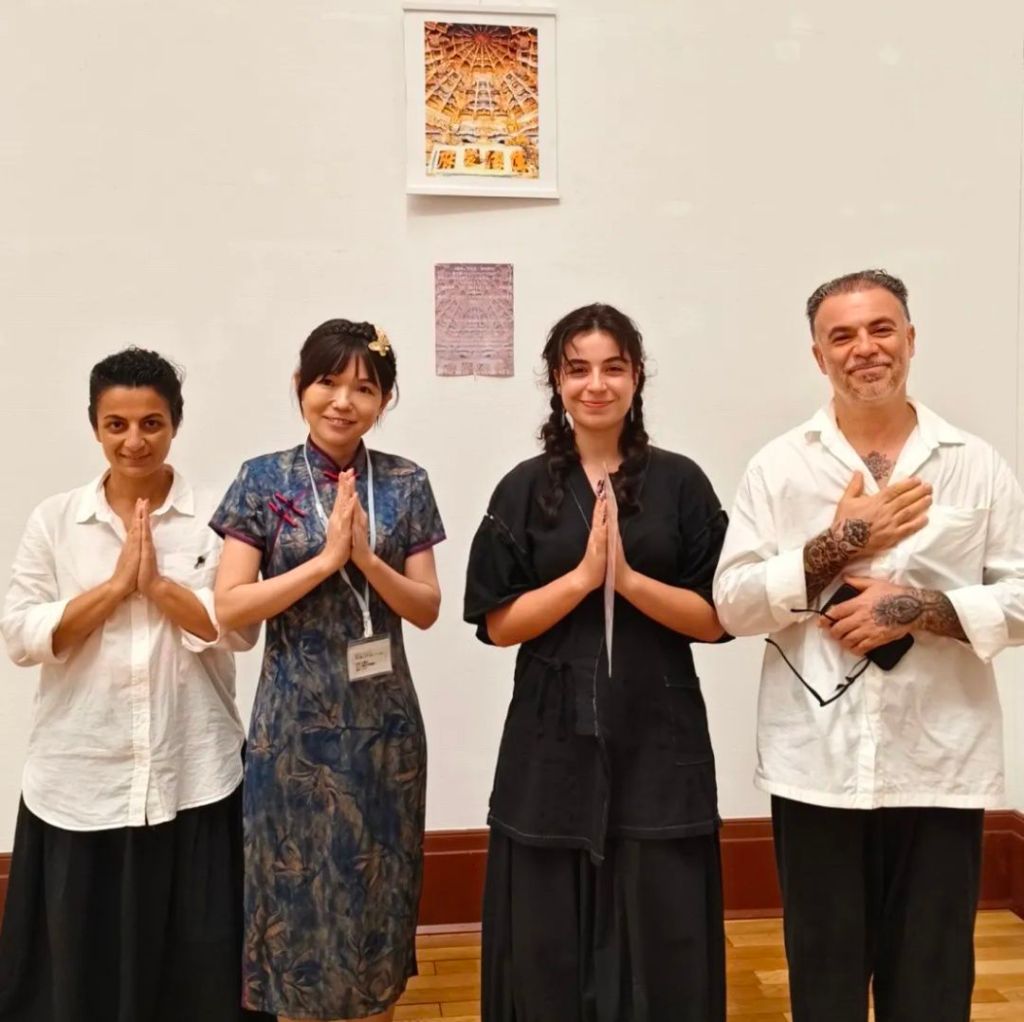
My exhibition, illuminated by the presence of Japan’s national treasure Yayoi Kusama, drew a vibrant crowd. Among the visitors were guests from an Islamic country who had traveled after hearing the Mindful Heart podcast.
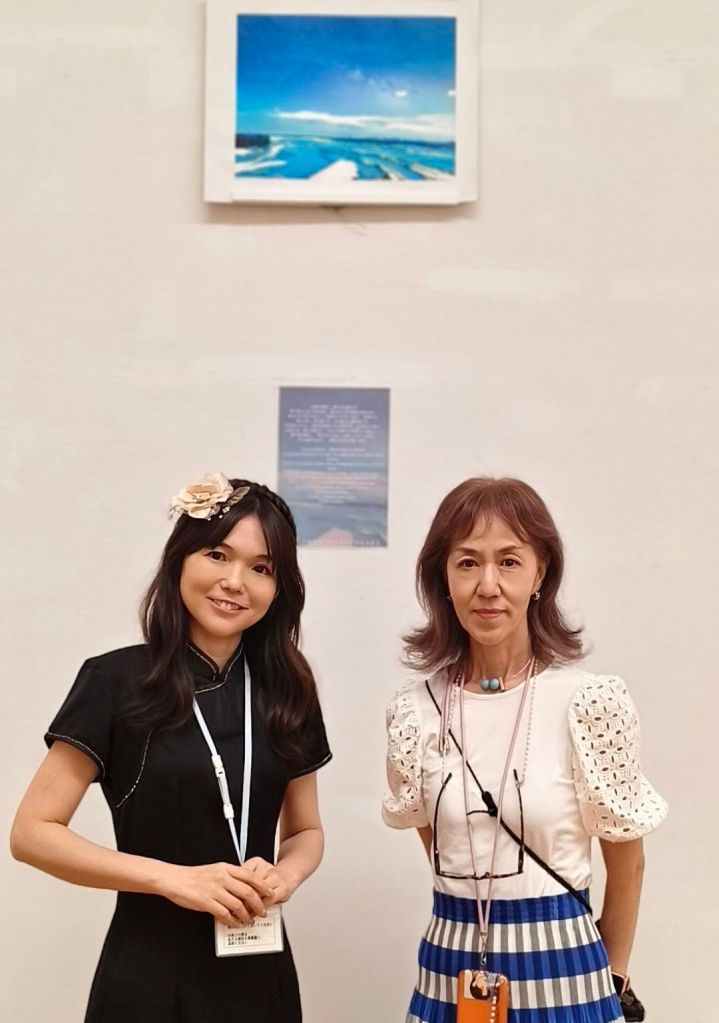
Though unfamiliar with Kusama, they expressed being deeply moved by my painting Lugang-Blessed by the Vast Sea. This work, weathered through centuries of storms yet still sheltering countless lives, carried a depth that transcended language. They stood in silence, seeing within it the breath of time.
When asked why they were not wearing headscarves, they explained with a smile: “This reflects the awakening of women’s rights in recent years. We want to step into the world as ourselves.”
In that moment, I realized that art is not mere form, but the freedom and stillness of the heart. Just as the weathered walls of Lugang and their clear eyes spoke the same truth, so too did cultures converge echoing the message: when the heart is pure, every place is a sanctuary.
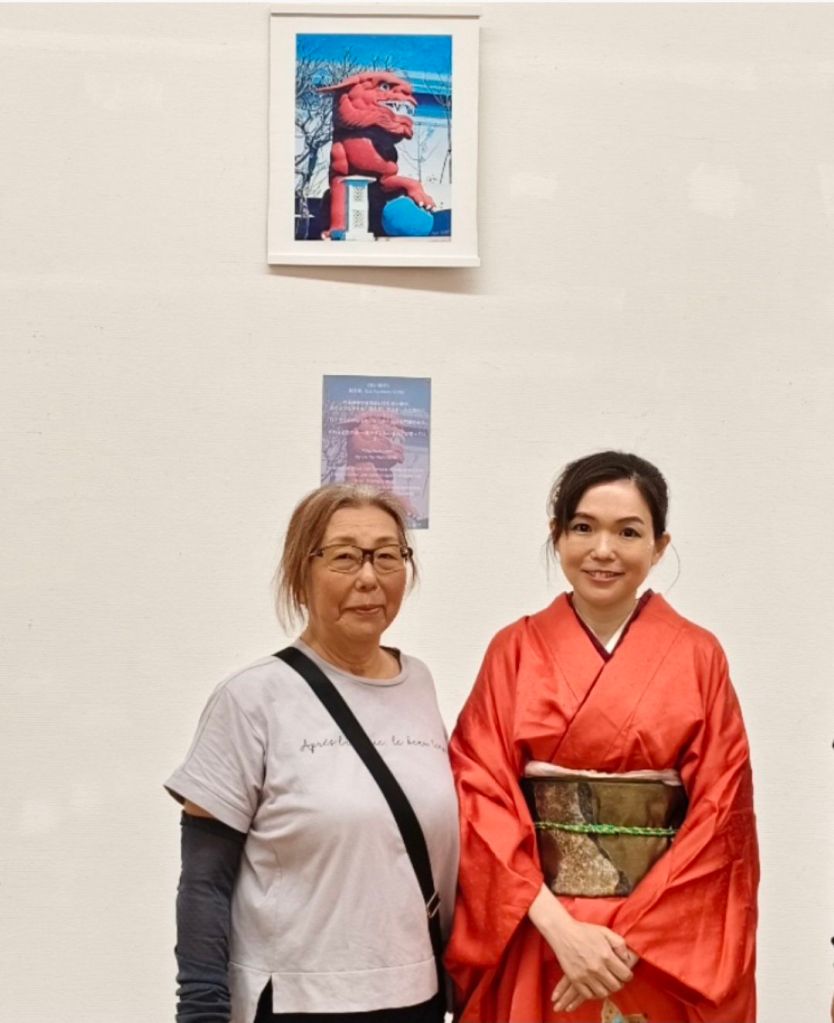
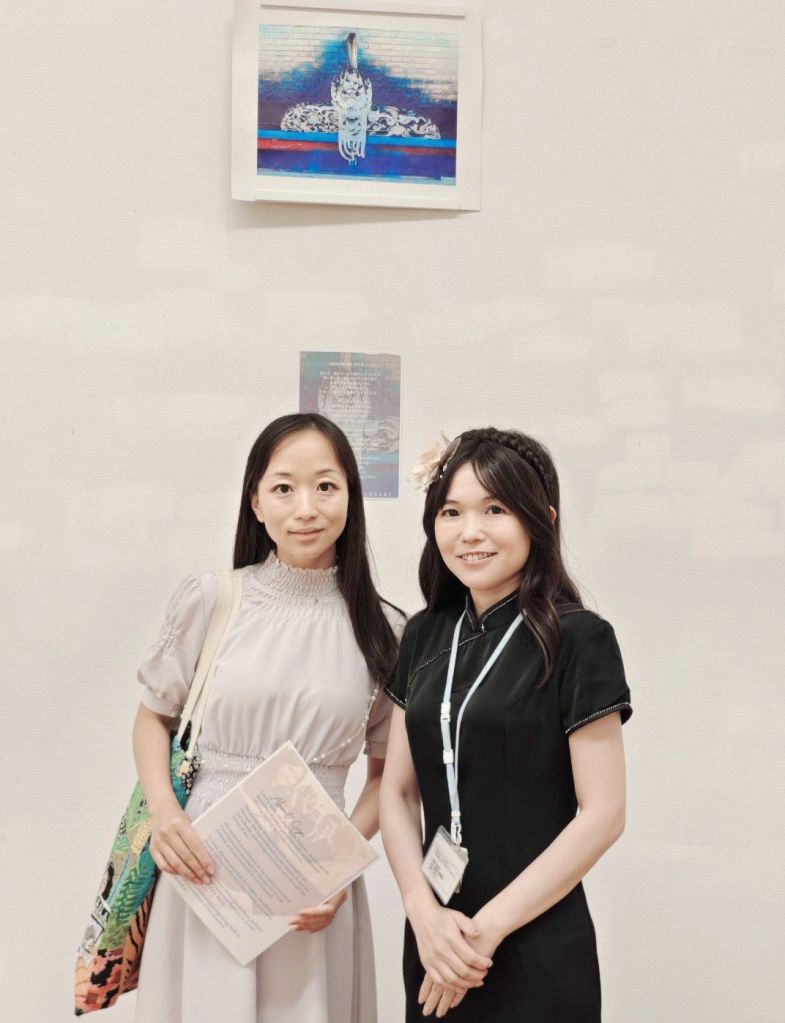
In Cyn’s canvas, the Lukang lion’s gaze is not fierce but compassionate -a silent watch that is both powerful and gentle. For a girl from Kansai, it awakened memories of the kindness of her Taiwanese classmates, reminding us that art crosses both time and culture. Here, the Lukang lion’s face becomes the “face of God,” revealing that strength and tenderness are one, and that every culture carries a sign that the heart has a refuge.
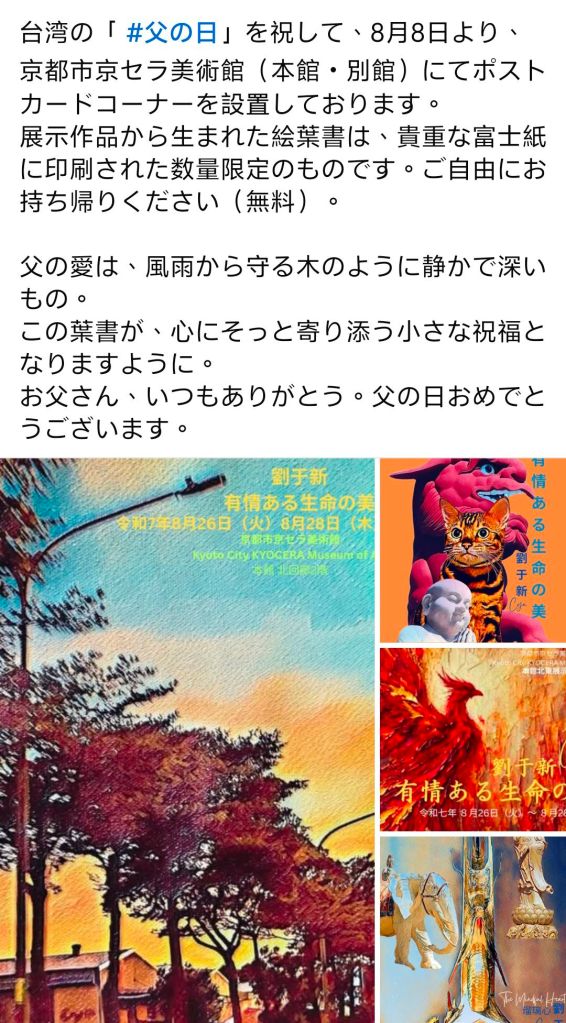
In celebration of Taiwan’s Father’s Day on August 8, a postcard station is set up at both the main and annex buildings of the Kyoto City KYOCERA Museum of Art. These limited-edition postcards, printed on fine Fujifilm paper, are derived from the exhibited artwork-free to take, and made to be cherished.
A father’s love is like a tree-quiet, yet sheltering. May these cards carry silent blessings, and gently reach the hearts of those who remember their fathers.
On a winter afternoon in the Southern Hemisphere, the sunlight of August 9th rested gently upon a quiet corner of New Zealand.
It was on this day that Professor Wu Alfonso departed peacefully from this world, at the remarkable age of one hundred and one. Like a towering tree returning its roots to the embrace of the earth, he left behind the dappled shadows of a life devoted to the nurturing of art, and the gentle protection of the human spirit.
“A century of nurturing people”-these words are not just the poetry of his name, but the true record of his life.
Born in the snowy city of Jilin in 1925, he journeyed through the turbulence of war to settle in Taiwan. In his hands, he carried not only the tools of his craft- the paintbrush and the chisel but also the guardianship of beauty, and the steadfastness of sincerity.
Graduating from the Royal Academy of Fine Arts of San Jorge in Spain in 1963, he returned to Taiwan and, from 1969, taught at the National Academy of Arts (now the National Taiwan University of Arts). Specializing in oil painting and serving as Director of the Sculpture Department, he shaped countless talents and laid enduring foundations for Taiwan’s sculpture arts. In the lecture hall, he lit the lamps of young minds; in his work, he extended the roots and branches of Taiwan’s art world.
By his side for sixty years was Professor Kuo Wei-Mei-;a flower blooming in the forest of art. The daughter of Master Kuo Po-Chuan, she inherited both his vision and his devotion. With her own hands, she restored her father’s former home into a memorial museum- not for her own name, but to let his love and his art continue to live in their hometown. Her paintings gather Taiwan’s mountains and seas into warm tones, like the gentle sunlight of April- soft, wordless, and deeply felt.
Life is not measured by the length of its days, but by the breadth and depth with which it is lived. Professor Wu’s century is a vast and generous forest. Professor Kuo’s art is a stream of clarity and grace. Forest and stream, standing together, reflecting one another- an eternal landscape.
Professor Kuo once offered this guiding thought: “Always keep yourself eyes up!”
To look upward is not to flee, but to refuse the confines of narrow vision, and to open the heart as wide as the sky. Today, her words drift like a gentle breeze, accompanying Professor Wu toward another boundless horizon, and watching over Professor Kuo as she continues her path of creation.
May we, in each breath, remember the uprightness of the tree and the blossoming of the flower. May our hearts be as fearless as the morning light, and as generous as the earth. Between each thought and the next- gratitude, blessing, and peace.